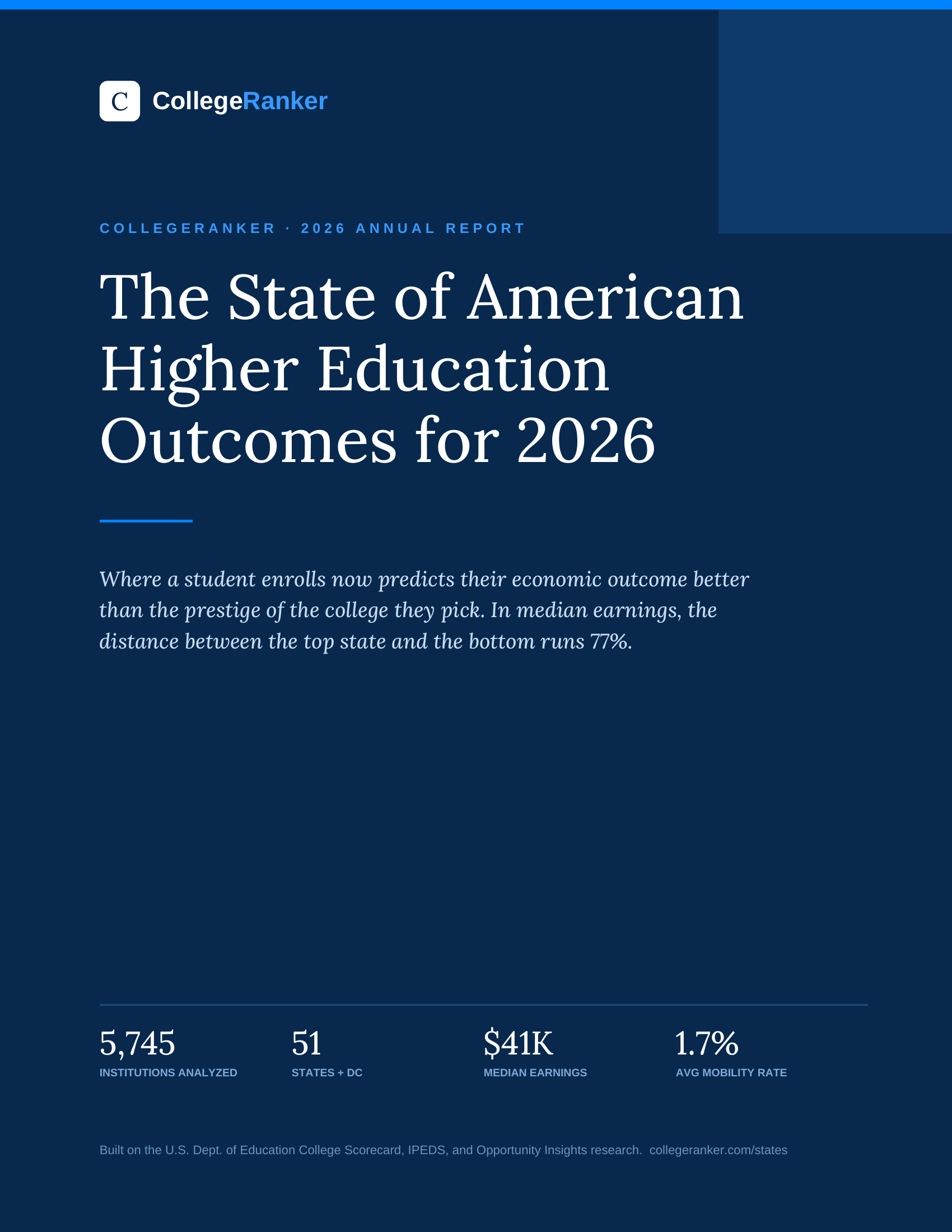
When researchers at Opportunity Insights matched 30 million anonymized tax records to college enrollment, they could finally answer the question rankings have dodged for decades: which colleges take students from the bottom of the income distribution and carry them to the top?
The answer is not the schools on the front of the glossy guides. Across the programs we track, the average "mobility rate" — the share of students who start in the bottom income quintile and reach the top — sits around 2.4%. A small group of public, regional, and commuter institutions clears 10%. Many of the most selective private universities, despite spectacular graduate earnings, barely register, because they enroll almost no low-income students to begin with.
Mobility is the product of two numbers most rankings never multiply together: how many low-income students a college admits, and how far those students travel afterward. A school can post sky-high earnings and still move almost no one if its freshman class is already wealthy.
The reason these colleges stay invisible is that the rankings industry measures the wrong end of the telescope. Selectivity rewards turning students away. Mobility rewards taking them in.
We weight social mobility the heaviest of any factor in our rankings, and it reorders the board dramatically — a few CUNY colleges, a clutch of California State campuses, and several regional publics leapfrog names with ten times the endowment. That is not a gimmick. It is what happens when you stop crediting a college for the privilege of the families it admits and start crediting it for the distance its graduates actually travel.
If you are a first-generation student, this is the single most useful number in higher education, and almost no one is putting it in front of you.
Mobility rate is not destiny. It rewards colleges in expensive labor markets and dense cities, where any degree pays off more, and it can flatter schools that simply happen to sit near high-wage industries. A high mobility rate paired with a thin graduation rate can also mean a college is admitting low-income students and then losing many of them — access without completion is its own kind of failure. The honest read is that mobility belongs at the center of the conversation, not that it should be the only number in it.
Enrollment officers we talk to are candid that the incentives still point the other way: boards, bond raters, and legacy rankings all reward a lower admit rate and a higher average SAT. Until a mobility number sits next to those on the dashboard, the colleges doing the most lifting will keep being penalized for it.